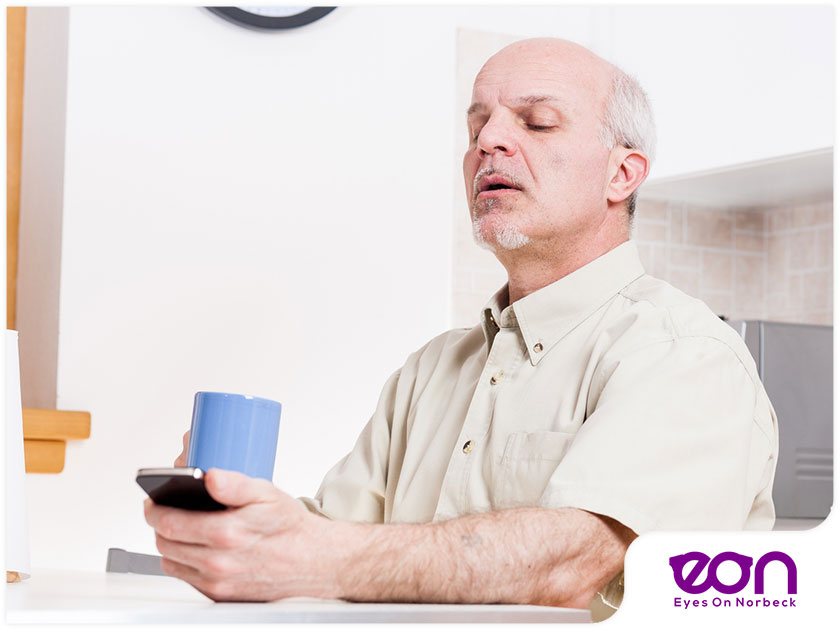
Recently a gentleman, who was a physics teacher came to the out-patient department for a second opinion. His complain was that he has been wearing his reading glasses sincerely since past 2 years. And so, he was convinced that since he was wearing them regularly, his doctor will ask him to take them off when he goes for his review check up. But he got shocked when his doctor told him that his number has not gone, but it had increased. He was in total disbelief and that’s when he thought of taking a second opinion.
Source: Google images
The refractive error that this gentleman has is called presbyopia. It is an ageing process and it is as sure to happen as greying of hair. In fact, the term presbyopia comes from a Greek word which means ‘old eye’. After the age of 40 years, our eyes gradually lose the ability to see close objects clear. So, we begin to hold them farther away. We become aware of it when we start holding books, newspapers and now-a-days mobile phones at arm’s length to be able to read them. Let us understand why this happens.
Why does presbyopia occur?
We have already seen what happens when we look at an abject that is far away. In a nutshell, the parallel rays of light from a distance enters our eyes and get focused on to the retina. But things get a bit complex when we look at an object that is within the reading distance, i.e., 25-33 centimetres.
Light rays from a farther distance focusing on the retina
When we look at a near object, our lens has to work more to focus the image onto the retina. It is able to do so with the help of the circular muscles around it which is called ciliary muscles. When these ciliary muscles contract, they change the shape of the lens; it becomes more globular and hence its ability to focus light increases.
Light rays from reading distance focusing on the retina due to changes in the shape of the lens
With the increase in age, the lens becomes more stiffer and the ciliary muscles are not able to act as efficiently as before. Now, while trying to read something up close, the rigid lens is not able to change its shape, and hence, can’t focus on close-up images.
The lens becomes rigid with increasing age and light focuses behind the retina
A convex (or plus lens) is used to make the light focus on retina again
Age and your glass number
So, you see it is because of our increasing age that the strength of ciliary muscles and flexibility of lens to change shape will decrease. And there is no way to stop or reverse the normal aging process. Therefore, if your age increases, so will your reading glass number.
It does not matter that you are using your glasses regularly or not. Glasses are not a treatment option. They are not like a pill that you take to treat your fever, they are like hearing aids that you use to hear clearly. The concept is similar to the one that we discussed regarding myopia and glasses in children. Your age increases, your glass number will increase.
Source: Google images
Why should I wear glasses then?
After understanding all this and still feeling disappointed, his next question was, why should I wear glasses if they don’t treat my condition. The answer is simple- comfort. If you use glasses while reading, you will be able to see clearly. You will be able to do your job better. This means your eyes won’t have to put in extra effort trying to make blur images clear, this means no headache or eye strain.
In conclusion, if you are someone who is around 40 years of age and need to hold mobile farther away to read the messages, it is very likely that you need glasses. Even if you wear these glasses regularly, make sure to visit your eye doctor at least once a year because as you age, your number will change and you have to make a new pair of glasses.