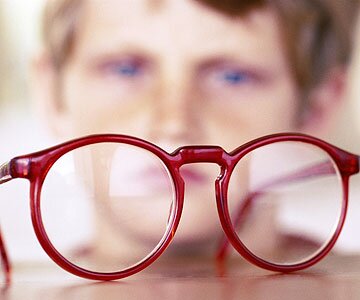
Breaking the news to parents that their child has low vision and needs to wear glasses is not as easy as it used to be, especially when they have come for non-visual complaints like itching. Truth be told, the trend is changing. Many children are being detected with refractive errors on routine eye examination. In our study we found that almost 60% of patients diagnosed with refractive errors presented to our clinic with complaints that was not related to vision, like headache, watering of eyes, itching and routine check-up.
In such scenarios, parents go through the same five stages of grief; denial, anger, bargaining, depression, and acceptance. Before they come to the terms that their child needs glasses, they cannot wrap their heads around as to Why did their child get glasses? As pediatric ophthalmologists, it is our job to help them pass through these phases as comfortably as possible. Let us try and answer the burning question of WHY.
This is the optics of a child who doesn’t have a refractive error (emmetropia). The rays of light which are coming from infinity gets focused exactly at the retina.
The light falls on the front surface of the eye i.e., the cornea.
The light undergoes refraction and gets focused perfectly on to the back portion of the eye i.e., the retina.
Now, since you know that it is because your kid’s eyes are bigger than normal, that he/ she needs glasses to see clearly, we shall discuss the reasons for myopia.
Causes for getting a glass number:
One thing to remember here is that, there is no single cause for refractive errors. There are multiple factors which interact with each other altering the eye in a way that the child gets glasses.
Outdoors– Outdoor activities have proved not only to reduce incidence of myopia but also to inhibit progression of myopia in children. Physical exercise augments this effect.
Near work– Prolonged near work and close viewing distance are known risk factors for myopia progression. In many studies, smartphone showed worse deterioration than printed text.
Diet– Myopic children are found to have low Vitamin D3 and are over weight as compared to non-myopic children.
Sleep– Children who sleep less have higher risk of developing myopia.
Ambient light– Dimmer the ambient light, higher is the resultant refractive error
Socioeconomic status– Myopia is more common (2.6 times) in children with higher socioeconomic status and living in urban area. This may be because they spend more time indoors with greater near work demands.
Genetics- History of use of glasses in parents is important. The child with one parent using glasses is at 1.5 times higher risk of getting glasses (as compared to children with no myopic parents). This risk doubles to three times if both parents are myopic.
Once the parents accept the fact that their child is going to need glasses for the rest of their lives, they want to know what can they do next?
Well, there are few modifications that you can do in their lives which will help to slow down the progression of myopia, at least.
During online classes-
Those who have glasses, should wear them during online classes as well
Use as bigger screen as possible (prefer laptop over mobiles) and bigger working distances (keep them as farther away as possible)
Ask your child to blink frequently
Sit near a window with good natural lighting
Follow 20-20-20 rule (Take break after every 20 minutes for 20 seconds to focus at 20 feet away)
Maintain good posture
Make sure that in between lectures, child is not using electronic devices
Lifestyle changes:
Spend 2 hours outdoors at least
Physical activity
Good sleep (at least 7-8 hours per day)
Balanced diet and well hydrated
Consult your paediatric ophthalmologist at least once a year
Remember, we cannot make the glasses disappear, but we can definitely slow down the progression of myopia. Wearing glasses brings a new set of challenges and experiences in your child’s life. Let’s make it a pleasant one.