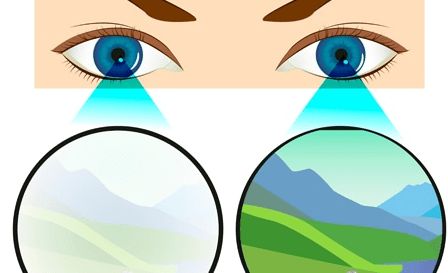
If telling parents that their child has glasses is difficult, telling them that child has amblyopia too is a backbreaker. Amblyopia or lazy eye means the vision in one or both eyes has not developed properly and even with full refractive correction, the child is not able to read the last line on vision chart.
Many parents find it hard to believe that something like this can happen to their child, when especially the eyes look “perfectly fine” to them. So, let us try and understand what and how of amblyopia/ lazy eye in very simple terms.
First things first
First thing to understand here is that amblyopia is a condition that develops only in childhood. During first 8 years of life vital connections form between a child’s eyes and brain. Anything that blocks or blurs vision in one or both eyes can prevent or slow down these connections from forming.
If these connections are not properly formed, the brain begins to ignore the images seen by the weaker eye, and the eye begins to lose vision. This eye is then referred to as “amblyopic.” It is pertinent to remember here that the eye from outside may look absolutely normal.
So, for the visual system (connections between eyes and brain) to develop properly, the brain must simultaneously receive a
clear,
focused,
properly aligned image
from each eye
Images from both eyes are received by the brain, who combines them and the child sees a 3-D image.
When the brain receives a clear, well-focussed and properly aligned image from both the eyes, strong connections are formed between the eyes and brain.
What causes amblyopia?
There are three main reasons why a child may develop amblyopia.
Strabismus/ squint (cross- eyes)
Strabismus is when the eyes point in two different directions. One eye may be focused straight ahead while the other may turn in any direction (in, out, up, or down). To avoid seeing double, the child’s brain ignores the image from the eye that is not focused straight ahead. But in this bargain, the eye doesn’t develop properly.
Left eye has turned in (esotropia)
The image is neither clear, nor focussed, not properly aligned. Hence, left eye is ambyopic.
2. Refractive error
A child may have a refractive error that is worse in one eye. The brain ends up “turning off” the eye and vision will not develop properly. This is the hardest one for the parents to believe because while using both the eyes, the child’s vision seems fine.
The left eye bigger in size, and hence myopic.
The left eye can't form a clear and focussed image and hence, is amblyopic
Sometimes both eyes may have high, yet similar refractive error. In such cases, vision in both the eyes may be less.
Here, both the eyes being highly myopic, can't form a clear and focussed image and hence, are amblyopic
3. Deprivation amblyopia
Deprivation amblyopia develops when one eye is deprived of clear visual signals. This can happen in childhood cataracts (yes, even children can develop cataract) or severe ptosis (lid covering the eye).
Left eye has cataract, hence the image is not clear or focussed.
The connections between left eye and brain cannot develop properly
How will you know that your child has lazy eye?
The truth is that you can never be sure if your child has lazy eye or no, unless you get an expert opinion (and I don’t mean from the elderlies at home or your neighbour).
Children rarely complain that they have issues with their vision. So, here are some clues that can help you:
you notice that your child has squint (cross- eyes)
your child goes closer to watch TV or holds book very close
child may squint their eyes while trying to see something
general clumsiness due o lack of 3-D vision and depth perception
Take away message
Treating amblyopia means waking up the connections between the eye and the brain (we shall discuss that later) which by now you must have understood is a difficult task. So, the saying prevention is better than cure fits the situation perfectly here. Please make sure your peadiatric ophthalmologist checks your child’s eyes at least once by their 3rd– 4th birthday. This is the only way to be sure that your child’s eyes are performing to their optimal capacity.